
Getting new floors is exciting. You get to pick the perfect wood, colour, and finish. But let’s be honest: that excitement often comes with a knot of anxiety about the price tag.
Oak is Canada’s favourite hardwood for good reason: it is beautiful, super durable, and a great investment for handling Toronto winters and years of family life. However, what you see on the showroom sticker is almost never what you end up paying.
Many Toronto homeowners are surprised by the hidden costs that creep into their flooring budget. Details like the material grade, plank width, subfloor condition, and installation method can significantly affect the overall cost, and these variables aren’t always clear when you first start shopping.
We wrote this post to give you an honest breakdown. Our goal is to help you build a realistic budget so you can buy your new oak floors with full confidence.
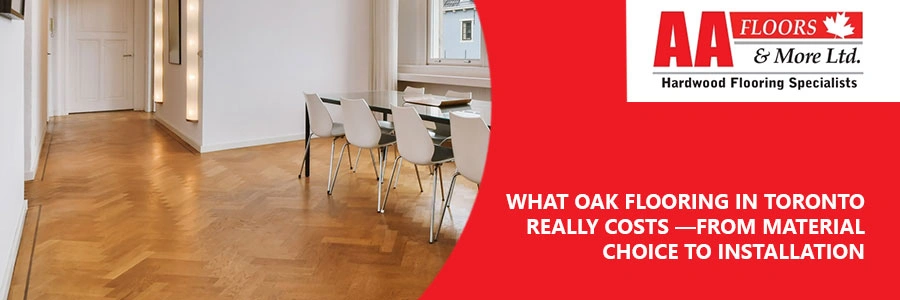
What Oak Flooring in Toronto Really Costs—From Material Choice to Installation
The total cost of your flooring project depends on a few key decisions you make upfront. When you know what those are, the final numbers make a lot more sense.
1. Material Cost: What You Pay Per Square Foot for the Wood Itself
The wood itself is where your budget begins. For oak flooring in Toronto, material-only prices typically run between $4 and $13 per square foot, depending on the wood’s species, grade, and construction type. You’ll find entry-level solid red oak in a narrow strip format at the lower end of that range. The price increases as you choose higher grades with cleaner grain and fewer natural markings. White oak, which has a tighter grain and cooler tone that pairs well with modern Toronto interiors, commands a modest premium over red oak.
The wood’s grade is also a huge factor here. A lower-grade board will have more knots, colour variation, and character marks, which many homeowners actually love! A higher-grade board offers a more uniform, refined look. This grade isn’t just about aesthetics; it also affects how the floor will look after sanding and refinishing ten years from now. Understanding the grade before you shop gives you control over both the initial look and the long-term cost of your investment.
2. Solid vs. Engineered: Construction Type Changes the Price Significantly
Choosing between solid and engineered flooring is a huge deal, and it impacts your budget more than you might think.
Here’s the difference: Solid hardwood is made from a single, thick piece of wood (usually three-quarters of an inch thick). This means you can sand and refinish it many times over its lifespan.
Engineered hardwood is different. It has a real wood layer (the veneer) on top of a super-stable core, often plywood. This construction makes engineered floors much better at handling the temperature and humidity changes we see in Toronto throughout the year.
For the material itself, engineered flooring typically costs between $5 and $12 per square foot. The higher end of that range is for wider planks or those with a thicker veneer. Solid oak materials fall into a similar price bracket but can be more expensive for the highest quality grades.
A major plus of engineered oak is that it works in places where solid wood struggles, such as over radiant heating or in finished basements where moisture is a concern. Picking the right type for your specific space is critical and can save you from expensive fixes later.
3. Plank Width: Why Wider Boards Cost More
The plank width often surprises people. Standard strip floors are about two and a quarter inches wide. Moving up to three inches adds a small cost increase. But when you jump to four, five, six, or seven-inch planks, the price goes up a lot—and it completely changes how your room looks.
Wider planks really let you see the wood’s natural grain, making your space feel more open and custom-designed. They are also harder to produce and install, which is why they cost more. Wide planks, especially white oak that is five inches or wider, are at the top of the price range. That’s because the boards need careful drying, precise cutting, and a lot of skill to install them perfectly flat. For example, a five-inch white oak plank will cost significantly more than a three-inch strip of the same wood.
If you want a wide-plank look, include it in your initial budget to avoid any shock later.
4. Finishing: Prefinished vs. Site-Finished Oak
The way your floor gets its final protective coat is another cost variable to consider.
Prefinished oak comes from the factory already sealed with multiple coats of finish cured under UV light. This speeds things up: installation is quicker, there is no drying time, and your home is back to normal in a day or two.
Site-finished floors are sanded and coated right in your home after installation. The huge benefit here is that you can choose the exact stain colour and sheen you want, giving you a perfectly smooth, continuous surface without the small micro-bevels between planks. The trade-off is the added labour cost, and you’ll need to stay off the floor for a day or two while the coats dry.
Expect site finishing to add roughly $3 to $5 per square foot to the total project cost, which covers the sanding, staining, and multiple coats of finish.
Both methods result in beautiful flooring. The right choice for you depends on your timeline, your design goals, and your budget.
5. Labour and Installation Costs in Toronto
This cost is what usually catches people off guard. To have oak flooring installed professionally in Toronto, expect the labour alone to cost between $3 and $7 per square foot. The final price depends on the specific installation method, the complexity of your space, and your installer’s experience.
There are three main methods:
- Nail-down is the classic choice for solid wood floors over a plywood base.
- Glue-down is best for concrete slabs because it provides excellent stability.
- Floating is the quickest and cheapest option, where the planks lock together over a cushion layer. This method works well with most engineered products.
Keep in mind that complex areas—like stairs, odd angles, or detailed patterns such as herringbone—require a lot more time and skill, which will raise your per-square-foot rate.
To get an accurate quote, make sure you discuss your room’s layout and any special design ideas with your installer beforehand.
6. Subfloor Preparation: The Hidden Cost Most Budgets Miss
You know that old saying: your new floor is only as good as what’s underneath it.
That’s definitely true here. Subfloor preparation is the biggest surprise cost for most homeowners, often popping up right in the middle of the job. If your existing subfloor has problems such as soft spots, squeaks, uneven height, or moisture issues, we have to fix them before we can lay the first plank.
Addressing tasks such as levelling the subfloor, replacing damaged plywood, or adding a moisture barrier will increase your labour costs. This is especially common in older Toronto homes—like those built before the 1970s—so you should definitely plan for it. Even a small levelling job for a few hundred square feet could add between $500 and $1,500 to your total bill. The absolute best way to prevent these surprise mid-project costs is to get a thorough subfloor check before installation even starts.
7. Waste Allowance and Room for Error in Your Budget
You’ll never use the exact square footage of your room. Professional installation always requires extra material to account for necessary cuts, inevitable waste, and the possibility of a damaged board. For a simple rectangular room, plan on needing about 10% extra material. If you are planning a diagonal or patterned layout, increase that to 15% or more.
Here’s another pro tip: buy a little extra material beyond the installation requirement. Oak is milled in batches, and the colour and grain of one batch rarely match the next perfectly. If you need to replace a board five years from now, having pieces from your original batch on hand will be invaluable. When you factor this into your budget from the start—instead of getting surprised at the checkout counter—your planning stays smooth, and your finished floor remains consistent.
Now that you know the factors that affect its pricing—including grade, plank width, construction, finish, subfloor prep, and waste allowance—you can plan your oak flooring project confidently and avoid surprise costs. This is a smart financial decision for your home, not just an aesthetic one. AA Floors & More is a local resource worth visiting, offering the inventory, pricing, and expertise Toronto homeowners need to get the best value.
AA Floors & More Ltd.
524 Evans Ave Etobicoke ON M8W 2V4
TELEPHONE : (416) 201-9611
Click here to send Email
OPENING HOURS
Monday-Friday 8:00 am – 6:00 pm
Saturday 9:30 am – 3:30 pm
Sunday-Closed