
Their flooring faces more stress than most homeowners in Toronto realize, and nearly all of it goes unnoticed.
Temperature and humidity levels inside a home are constantly shifting, and laminate flooring responds to each of those shifts. The planks expand when the air is warm and humid, and contract when it is cold and dry. This cycle repeats hundreds of times over the life of a floor.
The problem is not the movement itself. After all, laminate is designed to move. The problem is when the temperature and humidity inside a home become too extreme in one direction—high or low—for too long. That is when gaps open, edges lift, and planks start to buckle.
Keep reading to learn how indoor temperature and humidity affect laminate flooring after installation and what the warning signs look like. We will also explain how to keep your floor in good condition through every season in Toronto.
Why Laminate Flooring Moves After Installation
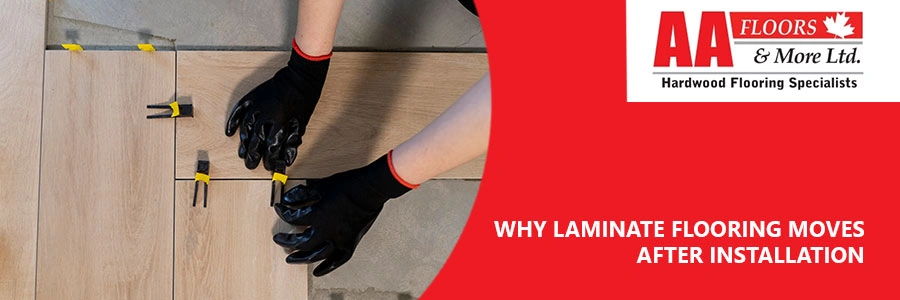
Most homeowners assume that once a floor is installed, it stays fixed in place. Laminate does not work that way. Understanding why laminate moves is the first step toward preventing damage caused by uncontrolled movement.
How Laminate Is Built and Why That Makes It Reactive
Laminate flooring is made from a high-density fibreboard core. In turn, this is made from compressed wood fibres bonded under heat and pressure. Wood fibres, even in processed form, still absorb and release moisture from the surrounding air. So, when moisture enters the core, the fibres swell slightly; when the air dries out, the fibres shrink. This process is called hygroscopic movement, and it happens in every laminate plank regardless of brand or price point.
The outer wear layer on laminate is sealed and moisture resistant. But the core beneath it is not fully sealed, particularly at the cut edges between planks. Moisture enters and exits mostly through those edges and through the underside of the plank. This is why the seams between planks are often the first place where damage becomes visible.
What a Floating Floor Installation Means for Movement
Most laminate flooring in Toronto homes is installed as a floating floor. The planks click together but are not glued or nailed to the subfloor beneath them. This is intentional. A floating installation allows the entire floor to expand and contract as a unit without cracking or splitting. The floor moves as a whole rather than fighting itself plank by plank.
The expansion gap left around the perimeter of the room, usually between eight and twelve millimetres, exists for this reason. It gives the floor room to expand outward without pushing against the walls. When that gap is too small, or when it is covered incorrectly by trim, the floor has nowhere to go and starts to buckle upward at the centre.
How Toronto’s Climate Creates Specific Challenges
Toronto’s seasonal extremes are harder on laminate flooring than those in most other Canadian cities. The temperature difference between a humid July and a dry January in a centrally heated Toronto home is significant enough to cause noticeable movement in an unmanaged floor.
The Summer Humidity Problem
Toronto summers bring relative humidity levels that regularly sit between 60 and 90 percent outdoors. In homes without air conditioning or a dehumidifier, indoor humidity can climb into the same range. At those levels, laminate planks absorb moisture from the air and expand. The expansion is mostly lateral, meaning the planks push outward toward the walls and toward each other.
When the expansion gap around the room is adequate, the floor absorbs this movement without visible damage. When the gap is too tight, the pressure has nowhere to go. The floor buckles upward in a wave shape, most often in the middle of the room where the cumulative expansion pressure is highest. Visiting a flooring store in Toronto to ask specifically about summer expansion allowances is worth the time, as not every installer accounts for local humidity ranges when setting expansion gaps.
The Winter Dryness Problem
Most Toronto homes use a furnace system that pushes heated air through vents across the house. That heated air pulls moisture out of the indoor environment consistently from November through March, and indoor relative humidity can drop below 25 percent during the coldest months. At that level, laminate planks release moisture and contract. The planks pull slightly away from each other at the seams. Small gaps become visible between planks, particularly in long, open areas of the floor.
These gaps are not always a sign of poor installation. They are often a direct response to low indoor humidity. The gaps usually close again in spring as humidity rises. But repeated cycles of extreme expansion and contraction over several winters can weaken the click joints between planks, causing them to separate permanently over time.
The Right Indoor Conditions for Laminate Flooring
Knowing the ideal conditions for laminate flooring gives homeowners a clear, manageable target. The goal is not to eliminate movement but to keep it within the range the floor was designed to handle.
The Recommended Temperature and Humidity Range
Most laminate flooring manufacturers recommend maintaining an indoor temperature between 18 and 27 degrees Celsius year-round. The recommended indoor relative humidity range is between 35 and 65 percent. Keeping conditions within these ranges minimizes the expansion and contraction cycle to a level the floor can absorb without damage.
A basic digital hygrometer, a small device that measures indoor humidity, costs under thirty dollars at most hardware stores. Placing one in each room with laminate flooring gives a clear picture of whether the conditions are within a safe range.
How to Manage Humidity Through the Seasons
Controlling indoor humidity in Toronto requires active management in both directions. In summer, an air conditioner or standalone dehumidifier brings humidity down to a safe level. In winter, a humidifier connected to the central heating system or a portable room humidifier brings it back up. The goal is to keep the floor’s environment as consistent as possible between seasons.
Properly learning to maintain laminate floors through seasonal transitions involves more than just cleaning. Humidity control is a year-round responsibility that protects the structural integrity of the floor itself. Homeowners who manage this well consistently see their laminate floors last well beyond the manufacturer’s stated lifespan.
Warning Signs That Temperature or Humidity Is Damaging Your Floor
Damage from temperature and humidity extremes does not always announce itself immediately. Knowing what to look for makes it possible to catch problems early, before they require plank replacement.
Signs the Floor Is Expanding Too Much
Buckling is the most obvious sign. The floor develops a wave or ridge, usually running down the centre of the room. This happens when the planks have expanded to the point where the perimeter expansion gap is no longer sufficient to absorb the pressure.
Other signs include:
- Planks that feel raised or springy underfoot in specific areas.
- Visible gaps closing completely between planks along the entire length of a row.
- Trim or moulding pulling away from the wall as the floor pushes outward.
- A clicking or popping sound when walking across the floor in warm, humid weather.
Signs the Floor Is Contracting Too Much
Gapping is the primary sign of over-contraction. Thin lines appear between planks, running along the length of the boards. In mild cases, the gaps are barely visible. In severe cases, they are wide enough to trap dirt and debris.
Other signs include:
- Plank edges that feel slightly raised or rough to the touch.
- Click joints that feel loose when pressed.
- Cupping at the edges of individual planks where the sides lift slightly.
- Increased hollow sound when walking across sections of the floor
What to Do Before and After Installation to Prevent Problems
Most humidity-related laminate damage is preventable. The decisions made before and immediately after installation directly impact how the floor performs over time.
Acclimation Before Installation
Laminate flooring should be acclimated to the room where it will be installed before the first plank goes down. Acclimation means leaving the unopened boxes flat in the room for at least forty-eight hours; many manufacturers recommend seventy-two. During that time, the planks adjust to the temperature and humidity of the space. Installing planks that have not acclimated is one of the most common causes of post-installation buckling and gapping.
The room should be at its normal living temperature during acclimation. Acclimating laminate in an unheated garage or basement and then installing it in a conditioned living space defeats the purpose entirely.
Choosing the Right Product for Toronto Conditions
Not all laminate products are equally suited to Toronto’s climate range. Higher-density cores absorb less moisture and are less reactive to humidity swings. Thicker planks (12 mm rather than 7 or 8) are more dimensionally stable. When you shop for laminate flooring in Toronto, ask specifically about the product’s performance in high-humidity and low-humidity conditions. A good retailer will have that information and will match the product to your specific installation environment.
AC rating also matters here. A higher AC rating indicates a harder, more durable wear layer, but the core density is what determines how the plank handles moisture. These are two separate specifications worth asking about before committing to a product.
Laminate flooring is a practical, durable choice for Toronto homes, but it performs well only when the surrounding conditions are properly managed. The core of every laminate plank responds to the moisture in the air, expanding in humid summers and contracting in dry winters. Keeping indoor humidity between 35 and 65 percent, maintaining consistent room temperatures, and allowing adequate expansion gaps during installation are the three things that make the biggest difference. Catching early warning signs like buckling, gapping, or loose joints prevents small problems from becoming expensive ones. Maintaining flooring in Toronto over the long term requires attention to the environment, not just the surface. For guidance on the right product for your specific space and conditions, get in touch with AA Floors & More Ltd.
AA Floors & More Ltd.
524 Evans Ave Etobicoke ON M8W 2V4
TELEPHONE : (416) 201-9611
Click here to send Email
OPENING HOURS
Monday-Friday 8:00 am – 6:00 pm
Saturday 9:30 am – 3:30 pm
Sunday-Closed