
Concrete floors have become increasingly popular in modern Toronto-area interiors. Condos, renovated lofts, and minimalist homes often feature these grey surfaces, which suggest a raw, industrial finish.
While real concrete floors attract attention for their appearance, many homeowners question how practical they are for everyday living. This curiosity has led to growing interest in cement-style laminate flooring. Although that description may be confusing, the idea is simple: its surface looks like concrete without the physical properties of poured cement.
Keep reading to understand how cement-look laminate flooring compares to real concrete floors in terms of comfort, cost, installation, and suitability for Toronto homes.
Understanding Cement-Look Laminate Flooring and Real Concrete Floors
First, it is important to understand what each flooring option is. Concrete and cement-look laminate may appear similar at first glance, but their construction and everyday behaviour differ in meaningful ways.
What Is Cement-Look Laminate Flooring?
Cement-look laminate flooring refers to laminate planks that are printed and textured to resemble concrete. The flooring itself is not made from cement. It is a layered product that includes a durable top layer (i.e., the wear layer), a decorative image layer, a dense core, and a stabilizing backing.
The decorative layer is where the concrete’s appearance comes to life. Manufacturers use high-resolution printing to recreate the subtle colour variation, fine texture, and matte finish associated with concrete floors. Some planks also include light surface embossing, which helps reduce the flatness that often gives away imitation materials.
Laminate flooring with a cement look is chosen primarily for its visual appeal. It offers a modern, industrial appearance while retaining the warmth and comfort associated with laminate. For many homeowners, this combination makes it a practical option for living spaces that need both durability and visual restraint.
In laminate flooring for Toronto homes, cement-inspired finishes are often selected for condos, minimalist homes, open plan living areas, and renovations where existing concrete subfloors already exist beneath older flooring.
What Are Real Concrete Floors?
Real concrete floors are created by pouring concrete on site or by polishing an existing concrete slab. Once the concrete cures, the surface may be ground, polished, stained, or sealed to achieve a smooth finish. This process is common in industrial buildings and has been adopted in residential spaces over the past decade.
Concrete floors are valued for their solid appearance and minimal visual pattern. Each floor is unique, shaped by the curing process, aggregate exposure, and finishing method. This individuality appeals to homeowners who want a surface that feels permanent and raw.
However, concrete floors are structural elements rather than surface coverings. Their installation or modification often involves heavy equipment, extended timelines, and careful preparation. Repairs can be complicated, and surface imperfections are difficult to correct once the floor is finished.
Comparing Cement-Look Laminate with Real Concrete Flooring
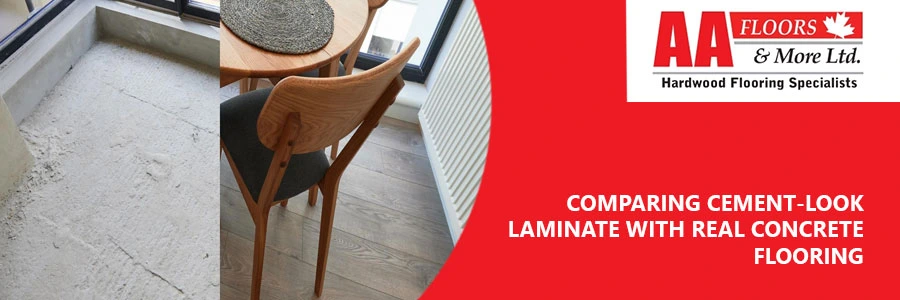
Once the materials are clearly defined, the comparison becomes more meaningful. Appearance alone does not determine whether a floor will suit daily life. Comfort, maintenance, cost, and long-term usability all play significant roles in your choice of flooring materials.
Appearance and Design Flexibility
Both options aim to create a modern, understated surface, yet they achieve this in different ways. Real concrete floors display natural variations. Hairline cracks, tonal shifts, and surface marks are common and often embraced as part of the material’s nature.
Cement-look laminate flooring offers a more controlled appearance. Planks are designed with balanced colour distribution and subtle pattern repetition. This creates a cleaner look that works well in smaller spaces where heavy visual variation may feel distracting.
Laminate also offers flexibility in tone. Homeowners can choose light grey, warm grey, or deeper charcoal shades depending on the surrounding decor. Concrete floors are more limited once poured and finished, making later adjustments difficult.
For laminate flooring in Toronto condos, where lighting conditions vary and space is often limited, this level of visual control is often preferred.
Installation Process and Renovation Practicality
Installation is one of the most noticeable differences between the two options. Cement-look laminate flooring is installed as a floating floor in most cases. Planks lock together and rest over an underlayment, which helps with sound reduction and comfort. The process is relatively quick and causes minimal disruption.
Concrete floors require a far more involved process. Pouring new concrete involves surface preparation, forming, curing, grinding, and sealing. Even polishing an existing slab can take several days and may generate significant dust and noise.
In renovation settings, especially in occupied homes or condominiums, laminate flooring is often the more realistic choice. Many buildings in Toronto have restrictions on heavy construction work, which can make concrete installation impractical.
Comfort, Warmth & Living Experience
Concrete floors are hard and cold underfoot. While radiant heating can improve their comfort, it adds cost and complexity to the job. Without additional measures being taken, concrete surfaces can feel uninviting during colder months.
Laminate flooring offers a noticeably different experience. Its layered construction provides a slight level of cushioning, and the surface remains warmer to the touch. Underlayment further improves comfort and reduces noise transmission.
This difference matters in daily routines. Standing for extended periods in kitchens, walking barefoot in living areas, or creating child-friendly spaces all benefit from a floor that feels forgiving rather than rigid.
In Toronto, where winters are long and indoor comfort is a priority, laminate flooring with a cement look often suits everyday life better than real concrete.
Maintenance, Repairs & Long-Term Care
Concrete floors are often described as low maintenance, but this claim deserves context. While sweeping and damp mopping are simple, concrete requires periodic sealing to prevent staining and moisture absorption. Cracks may develop over time due to building movement or temperature changes.
Repairing concrete is difficult. Patches rarely blend perfectly with the surrounding surface, and refinishing often requires professional equipment.
Laminate flooring requires routine cleaning with appropriate products and basic care to prevent moisture damage. If a plank becomes damaged, it can usually be replaced without disturbing the entire floor.
For homeowners who want predictability in their flooring’s upkeep, laminate provides a clearer maintenance path. This is one reason why laminate flooring remains a popular option in both new and older Toronto homes.
Cost and Long-Term Value
Cost comparisons often influence the choice of flooring material. Real concrete floors can be expensive, especially when you factor in labour, finishing, and potential structural preparation. Even polishing an existing slab can carry a high price depending on the condition of the concrete.
Cement laminate flooring generally costs less upfront. Installation is faster, labour costs are lower, and additional systems such as heating are optional rather than required.
The long-term value of laminate flooring is not limited to its impact on your home’s resale appeal. It also includes repair costs, comfort, and adaptability. Laminate flooring allows homeowners to update or replace surfaces more easily as tastes change.
In the Toronto laminate flooring market, many buyers see value in choosing materials that balance design trends with practical ownership.
Which Option Is Better for Toronto Homes?
The answer to that question depends on how the space will be used. Real concrete floors may suit certain loft-style properties or commercial-inspired interiors where hardness and permanence are part of the appeal.
For most residential settings, cement-look laminate flooring offers a more balanced solution to the challenges of comfort, cost, installation, and long-term maintenance typically associated with real concrete floors.
In Toronto homes, where climate, building rules, and lifestyle needs intersect, laminate flooring continues to serve as a reliable alternative to more demanding materials.
Choosing between cement laminate flooring and real concrete floors involves more than visual preference. Each option affects your flooring’s comfort, installation, maintenance, and long-term use in different ways. While concrete floors carry a strong design identity, they often require compromises that do not suit everyday residential living. Cement-look laminate flooring offers a practical way to enjoy a concrete-inspired appearance without the challenges associated with poured surfaces. For Toronto-area homeowners exploring laminate flooring, this option provides flexibility and comfort while fitting well within renovation constraints. At AA Floors & More Ltd., customers can explore a wide range of laminate flooring solutions that reflect modern design preferences while supporting the needs of real-world living.
AA Floors & More Ltd.
524 Evans Ave
Etobicoke ON
M8W 2V4
TELEPHONE : (416) 201-9611
Click here to send Email
OPENING HOURS
Monday-Friday 8:00 am – 6:00 pm
Saturday 9:30 am – 3:30 pm
Sunday-Closed